
Time Frame
4 Weeks
Role
UX Researcher, Product Designer
Deliverables:
UX Research
Product Design
Self-initiated
2025
Background:
Personalization tools existed within ChatGPT— custom instructions, memory, Projects — but they all operated reactively, organizing conversations after they happened rather than shaping behavior before they began.
As the sole designer, the goal was to design an added feature that felt native to ChatGPT's existing ecosystem — lightweight, responsive, and scalable — without adding cognitive overhead or duplicating organizational tools that already existed.

Discover :
Understanding divergent needs through user research
User interviews revealed how people wanted ChatGPT to show up for them. Professional users valued efficiency, systematic reasoning, and structured output. Personal users valued warmth, non-judgmental dialogue, and emotional reflection. The same product was being asked to do fundamentally different things — and responding to both groups identically was quietly failing both.
Affinity mapping across all interview data surfaced four recurring themes: clarity, cognitive load, reassurance, and control. The sharpest insight was that users wanted personalization but did not want configuration burden. They wanted ChatGPT to feel smarter, not require more setup work. That constraint became the central design challenge and shaped every decision that followed.

DEFINE :
Reframed around intent, not organization
How do we let users shape the AI's behavior before the conversation begins? This produced the Modes framework: lightweight, user-defined contexts containing two core components — scoped memory (what ChatGPT knows about the user in that mode) and instruction personalization (how ChatGPT responds in that mode).
Separating memory from instruction was an intentional structural decision. Memory answers "what should you know about me?" Instruction answers "how should you behave?" Keeping them distinct reduced ambiguity during testing and aligned with how users naturally thought about the problem.
Develop :
Early concept testing revealed a critical failure point — multi-step setup flows felt heavy, and users were reluctant to configure themselves upfront. The fix was AI-generated memory drafts: instead of asking users to articulate everything, ChatGPT would propose a short summary they could approve or edit in one step.
Structured usability testing across three tasks — discovering Modes, creating one, and using it in conversation — showed over 80% task completion without guidance. Confusion emerged around the memory versus instructions distinction, which turned out to be a microcopy problem, not a structural one. Modes entry were added to the chat interface, explanatory text was simplified, and copy was tightened until the mental model clicked.


Deliver :
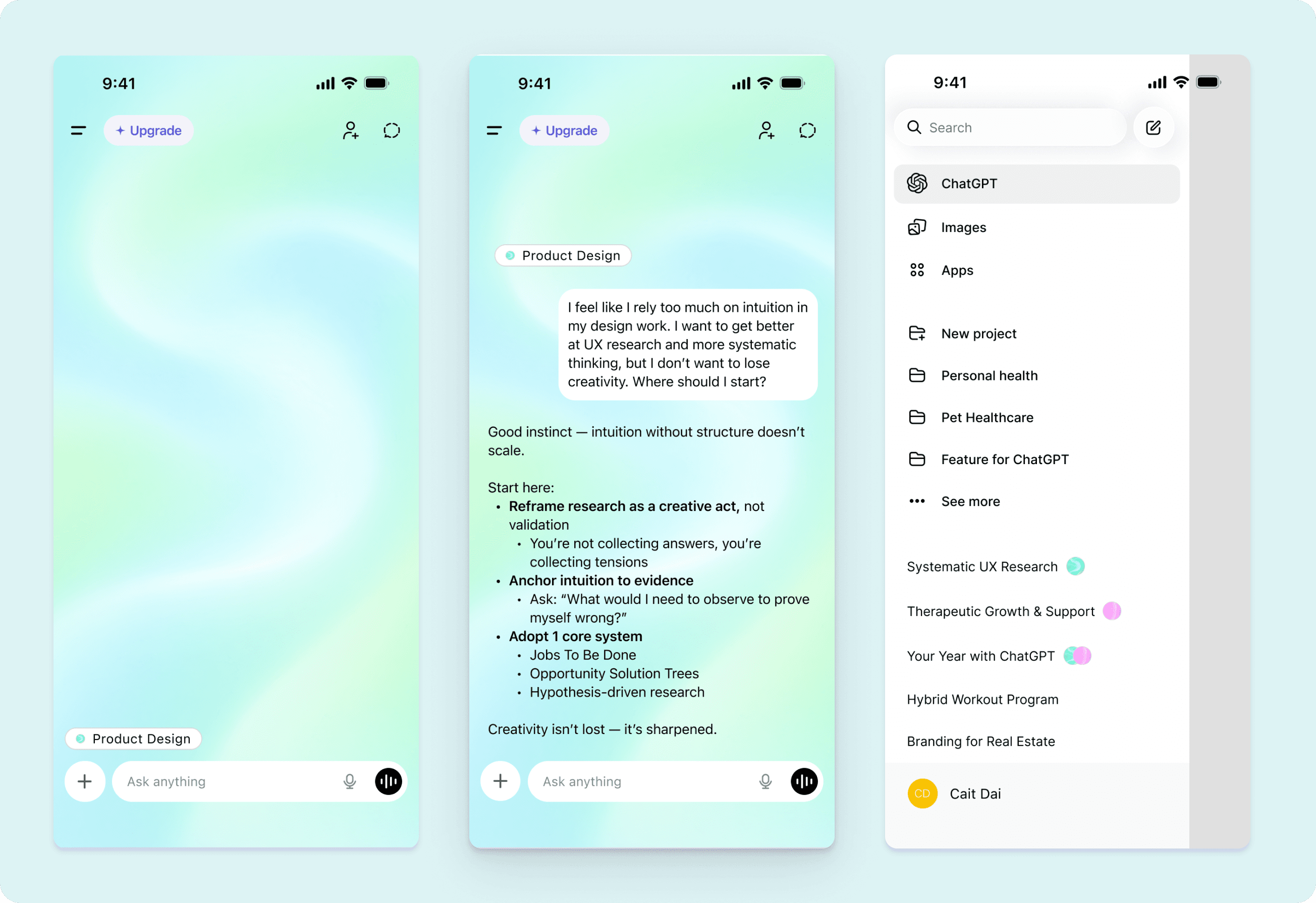
High-fidelity prototype: intelligence without interface weight
The final deliverable was an interactive Figma prototype covering discovery, setup, and in-chat activation across desktop and mobile. Visual indicators were intentionally minimal — Mode selection shifts ChatGPT's behavior without disrupting its clean, familiar interface. The framework was designed to scale: future personas, premium tiers, or role-based configurations could build on the same infrastructure without reworking the core interaction model.


LEARNINGS :
Personalization must reduce effort, not increase it.
The AI-assisted memory draft was the single most impactful design decision of the project — not because it was technically complex, but because it correctly identified where user motivation would break down and removed the obstacle before it could.
The fact that ChatGPT launched a comparable feature in the months following this project's completion was an unexpected form of validation. It confirmed that the problem was real, the direction was sound, and the timing was right.
